Sunday, March 19, 2017

RepubliCare - Working the Word, pt 1

Using RepubliCare as part of effective and strategic messaging.


     In a prior post, I argued that we shouldn’t call the new Republican “healthcare” alternative TrumpCare.  In that post, I used RepubliCare as a placeholder until we figured out a good name for it.  I got a lot of great responses from readers of that piece.  Those discussions eventually became like a very free-flowing focus group.  Most people preferred RepulibCare to any other alternative.

     The idea for the Don’t Call It TrumpCare piece comes from Frank Luntz’ Words that Work.  Words that Work is the playbook that has guided Republican messaging since before Newt Gingrich was Speaker of the House.  I’ve seen Mr. Luntz in interviews a few times, and he exhorts us liberals to use the ideas in his book to become better at messaging.  Challenge accepted.  I took one for the team and read it.  Now, I’m relaying the information to the rest of my fellow progressives.


Challenge accepted.
Do these words work?


     In this piece and the next, we will take a look at 10 rules of effective messaging from Words that Work.  This is to help us progressives and liberals get up to speed with the underlying ideas of effective messaging.  Because I know that my readers are liberals, I know that they won’t just blindly accept my recommendations.  We liberals need to know the reasoning for an action before we will buy into it.  After that, I’ll briefly review each rule as it applies to “RepuliCare – the Republican Wealthcare Program.”

[A note on cites. For this article, I’m foregoing citation formats.  If you see it in quotes and it looks like a citation, then it is something pulled directly from the Words that Work.  I pulled these 10 rules out, and then put the book down so that I could get to writing.  There are at least a couple quotes that don’t separate gaps in the quote with ellipses.  Anything else is something that I wrote without noticing it in the book, but I don’t guarantee that those words don’t occur in the book as I wrote them.  I’m not going to bother with page numbers or any of that other stuff either.  Sorry, but it just takes too long, and I want to get this piece published.]


     The first rule is “Simplicity.  Use small words.  Most people won’t reach for a dictionary.”  When I read or write, I enjoy unusual words.  Sometimes the sound of a strange word gives the rhythm of a sentence better flow, and sometimes the precise definition of an uncommon word just fits perfectly to convey the exact meaning to be expressed.  I don’t apologize for using sesquipedalian (which means foot and a half long in Latin) words because the variety and intricacies of our language are part of what makes it so amazingly complex and beautiful.  Also, learning the meanings and etymologies, or histories, of these words expands our knowledge ever deeper into the way that we understand the world.  However, when we want to convey a point clearly, concisely, and quickly, then we need to keep it simple.  Lots of big words can also come off as pretentious.  So, we have to keep the words simple and common.


Simple words to convey the message:
Republicans will gladly harm the most vulnerable to line their pockets.


     The second rule is “Brevity: Use short sentences.  Never use a sentence when a phrase will do.”  Many of us liberals have seen this rule in action and hate it.  Republicans are great at distilling their messages down to simple phrases or even a word or two.   Us liberals hate it because many of our hot-button political issues are way more complicated than a 5-word sound bite.  We see it as part of the Republican policy to dumb down America.  If policy discussion stops at sound bites, then that is a correct analysis.  (More on this later.)  We have to understand that these rules are not about the best use of language to argue and discuss policy but is instead about the most effective way to get that message across.  How do we convey our message succinctly and concisely in a way that will resonate with others?  How do we make that message in a way that resonates not just with other people in our political tribe but also with middle-of-the-road voters?  

I began making memes like this to help convey our message.
Is it brief enough?  Does it send a message?

     Third, “Credibility is as important as philosophy.  If your words lack sincerity or contradict accepted facts, circumstances, or perceptions, they will lack impact.”  Yes, that brings up the orangutan in the room – how does Trump get away with lying all the time?  That’s why this Republican wealthcare proposal is a perfect vehicle to hit back against both Trump and the Republicans at once.  The underlying philosophy is consistent (I’ll explain that in a second), but the actual real world results are pretty stark. 

     Paul Ryan’s proposal is solidly rooted in the free market fundamentalism philosophy of Ayn Rand and is consistent in the sense of moving toward that fundamentalism incrementally.  If you’ve paid attention to the news coverage, though, many conservatives have been extremely critical because it’s not ideologically pure enough for them.  That’s because his proposal is a first step to gut the ACA and return us to the dystopian drama of poorly regulated health insurers.  The ideologues either don’t recognize this or are extremists to the point that they don’t care.  They want to go to the extremist free market all at once.  This is an advantage for us because, while RepubliCare is solidly rooted in ideological philosophy, it isn't rooted in reality.  This gives us an opportunity to drive a wedge between pragmatism and ideology.  Americans are pragmatic.  That gap between their fantasy land and reality is what we need to exploit.  We will do that with credibility by showing that their promises will bring misery instead of prosperity.


I think you meant "extreme enough"?


     Trump has lied repeatedly and with impunity for far too long.  As long as everything he said was in the realm of mere possibility or would only harm others, then people were so disenchanted with our politicians that they were willing to look the other way.  Now, however, many people are looking at the stark reality that, as scored by the Congressional Budget Office (CBO) they may very well lose their health insurance.  Now that they are beginning to see this, they are not willing to just blindly follow along.  Gone now are the claims of a mandate and calls to just give the Republicans a chance to implement their policies.  As I’ve argued in another article, we don’t need to convince the vast majority of Trump supporters.  He won the electoral college by about 0.06% of the electorate’s votes.  It won’t take much to unseat him.  A small fraction more than that will result in a wave election that gives Congress back to Democrats. 

Credibility is as important as philosophy.
He has no discernable philosophy.
Let's expose his lack of credibility.


     A corollary, a result that follows from this rule, is that if your words (or actions) don’t match expectations, then you will lose credibility.  That is happening now.  Trump promised universal coverage, lower prices, the ability to select the physician of your choice, and a full repeal of the ACA.  He raised expectations very high.   Of course, he was too lazy to even tell someone to make a proposal, so he got Ryan’s RepubliCare as a default.  RepubliCare is so toxic that Trump has asked that people not associate his name with it.  There are now many news stories of Trump voters who are scared and worried that they might lose their health insurance.  Many of these people now regret their votes.  These are the people we need to target in our messaging.  Their eyes and ears are slowly opening. 

When reality meets promised expectations.
So much for prosperity.

Trump promised so much winning for America. . .
Why is that these are the only people who win under RepubliCare?
     These first three rules form the basis for any effective message.  An effective message must be simple, short, and true (or at least tethered to reality.)  In the next installment, we will look at ways to craft that message to make it more memorable, and at a little practical advice to get the message out effectively. 

Is it simple?
Is it brief?
Is it true?


     There is one more issue that I want to address before we go.  I know that many of us progressives despise the Republican messaging machine because of the way that it stupefies our national discourse.  I share your disgust.  It may help to break this messaging idea down into two pieces: a slogan (or sound bite) and the full message.  The slogan is not supposed to do the intellectual work of carrying an argument.  That’s what civil discourse is for.  In Zen tradition, they use slogans, called mantras, but they are a little different from a slogan.  A mantra is a distillation of an entire line of thought compressed into a single phrase or sentence.  The notion is that those few words will call to mind the entire discourse of ideas that may run many pages in length.

     Our nation is shortchanged if we think we can end a discourse of ideas at sound bites and slogans.  We need to engage in discussions that uncover all the implied ideas in those slogans and hidden policy effects if we are to give our nation the respect it deserves as a nation founded upon enlightenment ideals.  In order to get to that discourse, we will need to use these slogans as an introduction to a discussion, not an end of discussion.  So, stay with me through the next piece as we go through the basics of messaging and slogans. It will make us more effective in getting our ideas out.

The next installment: RepubliCare - Working the Word, pt 2.


Semi-related content (comic relief):


     Thanks for reading.  I hope his piece helps to expand your thinking.  I'd love to hear what you think in the comments below.  If you thought it was good, please consider clicking on one of the sharing buttons below.  If you want to get the latest articles as they come out, there is a "Follow" button at the top right of the page.  Thanks again.

Tuesday, March 14, 2017

Socrates Strives Forward


Socrates Strives Forward

     In prior articles, I argued that Trump’s Removal Must Be Political, Not Psychological, and, as a Prelude to a Way Forward, that we have to begin by showing some pretty radical compassion to Trump supporters who are about as lovable as a porcupine crawling out of a cesspool.  If you’ve come this far Great! Thanks for sticking with me.

     When it comes to “confronting” these Trump supporters, it may be easier if we think back to the format of a debate that we talked about in Prelude.   Whose mind do we want to change?  Hopefully, that uneasy Trump voter, right?  Remember, it is the audience, not the debaters, who are most likely to change their minds.  So, how can we make these folks feel more like the audience, and not like a participant?

     Just as I was getting ready to post this article, I read a great piece about the philosopher Blaise Pascal i that offers a slightly different take on persuasion from what we normally think.  There were three main points in the piece.  First, to effectively persuade, we must try to see things from his perspective, and that means practicing some empathy.  Second, we must acknowledge either a good point about that person’s position or find some other commonality.  This commonality helps us to feel the same as the other.  It’s compassion  literally to “feel suffering with” the other person ii. Even Hillary acknowledged that Trump’s children turned out great and were very successful – that’s a commonality.  Third, once we have created a dialogue with that compassion, then we can suggest that there may be other possibilities that the other person hasn’t considered yet. 

     To make this happen, the first thing we have to do is to NOT ATTACK THEM.  We want them to listen and be open to us.  That means we have to listen to them first.  To start,  we have to recognize that many of these people feel desperate.  Many of them have worked hard and played by the rules, but they still find it more difficult to make ends meet every day.  They see the American Dream becoming nothing more than that – a fading memory of a dream – for their kids.  If you are having trouble with this, go watch Michael Moore in Trumpland.

     Seriously, right now, if you can’t find any sympathy for Trump voters, go watch that movie.  Listen to what Moore says.  He empathizes with these folks.  Now, his main audience is still liberals, so he pokes a lot of fun at conservative “ideas”.   (I do that too, over here.)  Honestly, I suspect that he is not empathetic enough to convince anyone in that theater, but it’s a real good start.  While you’re watching, notice how often he makes statements, and how often he asks questions.  He’s not just preaching.  Once you've watched it, you should have an idea of what these folks are going through. 

     Second, don’t attack their positions either!  Remember, we tend to think of our political positions as connected to our very identity.  I've read that it is more common for people to change their religion than their political party.  Political beliefs are central to people's perception of themselves.  If we attack their positions, they will feel personally attacked.  Attacking their positions means that we cannot find a commonality.  With empathy and listening skills, however, there is a way to still engage with these folks even if we have difficulty in finding a commonality.  Pascal called it "suggesting that there is something that they haven’t considered."

     For our purposes, we don’t want to “make a suggestion” in the sense of making a statement, if possible.  In logic and debate, that statement is called an assertion and is pushing an idea forward.  We can’t push these folks.  (For a lot of these folks, they have lost their good jobs through no fault of their own, and life has gotten pretty bad. They've been pushed around enough.)  Instead, we need to find a way to bring them toward us.  Instead, we want to get to a point where we ask a question.  It’s like the aikido and jujutsu idea of using an opponent’s energy to let them throw themselves.  Their energy is their anger, and it’s up to us to find a way to redirect that anger.  Assertions push against the anger, but a question creates an empty space where that energy can be transformed.  Specifically, we want to use the Socratic Method of questioning.

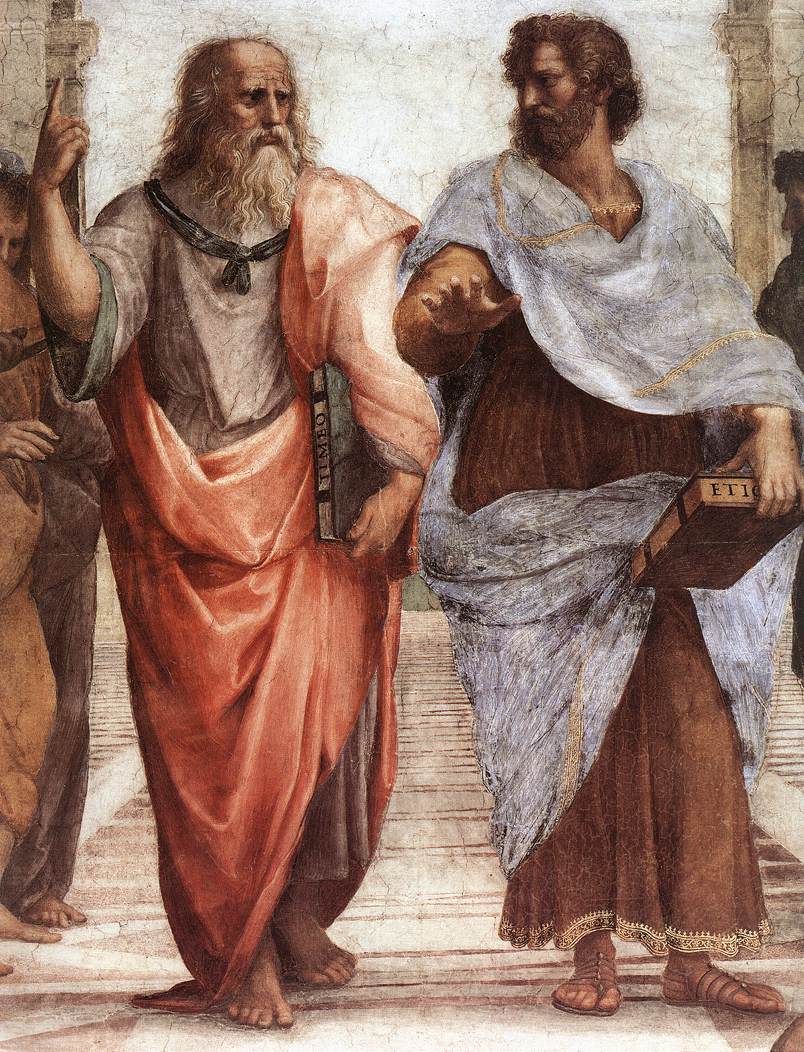
Socrates questioning and teaching a student.

     I was lucky to have a few classes with Dr. Oxhandler, the amazing professor that I mentioned in the last article.  He was one of those professors that didn’t try to tell us what to think but only asked us to engage in the process while we learned how to think.  He did this with many questions in his classes.  Even on writing assignments, if he saw a flaw in your ideas, he would not mark you wrong.  Instead, he would ask you a question to make you clarify your own ideas.

     Dr. Oxhandler gave me an introduction to what professors in law school would do.  They use the Socratic Method, which sounds very serious.  Don’t worry, it just means that you ask questions in a structured way to help the student move through the reasoning process, one small step at a time, to the ultimate truth.  The key is to structure and ask questions in an order that will take the person one small step at a time towards the truth.

     If you can learn the method, it works great.  (I currently teach English in Thailand and use this with my students.  They have told my department head many times that they love the way I do this to teach them.  From primary level teaching to graduate level – THIS METHOD WORKS.) The key is to design the questions so that the audience only has to take a small step at a time.  This keeps you engaged in conversation with the audience.  For those of you in the mental health profession, you are already very skilled at listening (and having empathy and compassion), and you have a set of topic areas that you routinely ask questions about.  You will only need slight modifications, if any, to make this method work.


     Now, on to some more specifics about how to ask these questions.  Keep in mind that we want the person engaging with us to feel more like an audience member than a debater.  So, after a Trump supporter points out some “alternative fact” that is obviously false, maybe we can ask, “Is this kind of spin consistent with our [personal, Christian, family, American] values?”  Notice, that I called it spin, and not a lie.  Again, we aren’t trying to attack, we are trying to have dialogue.

     In order for this to work, though, we also have to maintain control over the forum.  Whether it is a face to face discussion or an online forum, we must make sure the discussion is in a safe place where the person doesn’t feel attacked.  I have had a few situations where I was using this method online and a friend jumped in and attacked the person’s position (or the person herself).  That can instantly destroy the space, but we can also use it to our advantage.  When something like that happens, just play a little good cop – bad cop.  Stick up for the person you’re having the discussion with.  Point out that this person is a decent person who is a friend of yours, or that they may have a reason for their beliefs.  Not only does that protect the discussion space, it also makes you a little more of an ally and a little less of an adversary.  In Pascal’s words, it creates some commonality.

     Let’s take a look at how an expanded conversation might go about Trump’s “historic inauguration turnout”.  We’ve all seen the pictures of the crowds.  (We’ll discuss the people who are determined supporters in the next article.  For now, this is directed at someone who is starting to question their decision.)


1) You’ve seen the pictures, right?
Yes.

2) Which one, left or right, has the larger crowd size?
Left.

3) Yet, some people keep saying that the right had a bigger crowd size. Why?
Because they were taken at different times in the day.

4) Well, the photographer who took the 2008 photo stated that it was taken at 12:04 PM – the same time that the 2016 photo was taken.  That’s according to the time stamp from his camera.   Are you accusing him of lying?
No.

5) So, we know that the claim of the crowd on the right being larger is false, yet some people keep repeating it.  Is repeating known falsehoods consistent with your [personal, Christian, family, American] values?
 . . .

    It’s that simple.  The key is to break each question into one small step.  Using closed questions, those that only require one word or a yes or no answer, is a good technique to help keep the process from getting derailed.  There are a few other things to take note of as well.  First, in (3), I use “some people”.  I intentionally did not use Trump’s name.  People will have an attachment to him as part of their political identity, so avoid mentioning his name when you need to point out his misdeeds.  We have to keep that discussion space open for them.

     Second, in (4) - “Are you accusing him of lying?” is a pretty serious question.  A decent person will not make that accusation without proof.  If the Trump supporter does, then you have two options.  First, tell them that is a very damning accusation, and that they need to have support (or proof) for that claim in order to be taken seriously.  The second option, which you take if they refuse to provide any support, is to simply state that you have no desire to engage in further discussion with someone who refuses to remain civil.  It's not polite or civil to accuse someone of lying without proof, so don't engage with that.  It’s like the adage: don’t play chess with pigeons; they have no idea what they are doing and will only poop all over the board and strut around like they won.

     In (5), after walking toward each fact and getting confirmation, then we can ask a question that will give the person reason to split themselves from their former Trump loyalty.  Also, notice that I didn’t even refer to it as spin this time, and never called it a lie.  "Lie" and "spin" are too emotionally loaded.  Finally, it’s not important to get a response at this point.  In fact, it may even be a good idea to change the topic after the person has had a short moment to consider the question.  We don’t want to force them into an uncomfortable public confrontation, that will only trigger the backfire effect.  Again, keep that space open for them to move around.  They just might change direction and agree with you!

     Of course, it is nearly impossible that they will change their minds immediately.  That’s alright.  All we need to do is give them questions to consider and wrestle with.  I saw an interview with Neil Degrasse Tyson a while back, and he stated that it takes a period of months for a person to change their belief system.  So, a successful discussion should be judged by whether we keep the discourse civil, not by whether we changed a person’s beliefs.

     Finally, there are going to be some people that are just such die hard Trump supporters that they will not engage in anything approaching a civil discourse.  For a couple tips on dealing with these folks, go to the next (and last, I think) article in this series: Tolerating Trumpanzees in their Native Habitat.

Thank you for reading!  Did this article help you or change the way you think a little bit?  If so, I'd love to read what it did for you in the comments section below.  If you found this article helpful, you can share it, and there are sharing buttons below.  You can also follow this blog by clicking the "Follow" button at the top right.  Your help in getting this message out is sincerely appreciated.

Sunday, March 12, 2017

Don’t Call It TrumpCare

Don’t Call It TrumpCare

     The Republicans have finally unveiled their new healthcare plan.  It has been greeted with near-unanimous disgust.  Even some on the far right dislike it because it’s not conservative enough.i  Trump claimed that he would replace the ACA with something much better that would cover more people and at less cost. He made big statements like I’m not going to cut Social Security like every other Republican, and I’m not going to cut Medicare or Medicaid.” ii  Paul Ryan’s plan will break those promises and cover fewer people iii at much higher cost iv.  This plan is bad enough that Trump’s White House has even asked that we not refer to it as TrumpCare. For once, I agree with Trump and think that we liberals should accommodate this request for several reasons.  I would suggest that we label it “RepubliCare” for several reasons, not least of which is that I've already made several memes to help spread the word.  (You can grab them at that link, or copy them from this page.)

     First, this is Paul Ryan’s plan, not Trump’s.  Trump is fairly stupid and rather lazy.  Trump promised that he would provide universal coverage with better prices for everyone.v  He’s been promising that since he was campaigning.  This is just like his promise to release his tax returns if he decided to run, a promise that he made before he announced that he’d run.  So, where is Trump’s health care proposal?  Nobody has seen it – just like his taxes.  He has the resources of the entire executive branch and the Republican party at his disposal if he wanted to actually present a plan.  Where are the reports that Trump has even tasked anybody with drafting his proposal?  Nowhere.  Trump doesn’t care and didn’t do the homework he promised to do.  So, it is a little intellectually disingenuous to label it as TrumpCare.

What took Republicans so long?
They have been complaining about the ACA, and promising to repeal and replace, for 7 years.


     While Trump is not willing to work and not too bright, it is important to remember what he actually is.  He’s clever.  He has mastered the authoritarian handbook of blaming minorities for social problems.  He’s a master at distracting the public and the media with hyperbolic tweets to spread lies.  He’s very good at getting attention.  He’s a reality TV star.  He’s a drama queen.  He will dodge any responsibility for this disaster just like he has dodged responsibility through multiple bankruptcies - financial and moral - throughout his entire life.   As far as keeping with conservative principles, he’s a RINO – a Republican In Name Only.  Robert Reich wrote about a conversation he had with a Republican friend where the Republican said that they will tolerate Trump for as long as they must, then they will “pull the trigger”vi and get rid of him. This makes it crucial that we don’t pin this growing policy fiasco on Trump, but on the Republicans in general.

     If we accept that the Republicans really want a president Pence and will be more than happy to get rid of Trump, then we can’t focus all the negative publicity on Trump.  By most accounts, a president Pence would be far worse, and, with a Republican congress, he would be a disaster for the country.  Even if we doubt that they are happy to get rid of Trump, we can't just get rid of Trump and leave the Republican party standing.  Labeling this Republicare will have several benefits for us along those lines.

 They won the election in November, so why didn’t they have a plan ready to go on January 20? Were they lying, or just incompetent?

     If the Russian collusion is as bad as it appears to be, then Trump will be removed eventually.  He is also doing enough with stupidly written executive orders and baby-Nazi spokesmen who claim he “won’t be questioned” that he will get himself removed.  We won’t get rid of Trump because he’s crazy or mentally incompetent.  There is no quick fix for this and need to face political reality: it is nearly impossible that Trump will be removed from office in the near future.


     Let’s look at Watergate for some guidance.  Nixon’s “Plumbers” got caught breaking into the DNC headquarters in June of 1972.  Nixon was re-elected in November of 1972 and beat McGovern by one of the largest electoral landslides in history.  It wasn’t until August 1974 that Nixon finally resigned – over 2 years later.  So, we cannot focus on a quick fix, and must instead think about the long game.

     Right now, even though his poll numbers are the lowest recorded since pollsters started tracking presidential approval, he still has very solid Republican support and most of his base is still solidly behind him.  That’s not to say that all of Trump’s base is still behind him.  I’ve seen a half-dozen or so news reports that some of his supporters now truly regret voting for him, but that’s not enough.  In order to get rid of Trump, our goal needs to be twofold: eroding Trump’s support and eroding support for the GOP more generally.  Because of Watergate, Republicans lost 49 seats in the House and 4 in the Senate.vii  Those gains would be enough to swing both houses of congress back to the Democrats if they can capitalize on Trump’s many and growing scandals.  If Republicans take that large of a hit in 2018, then several other things will happen that will help get rid of Trump.

     First, a loss like that would ensure that even a president Pence will be nothing more than a lame duck.  Even taking just one house of congress would be enough to hamstring the Republican’s most destructive ideas.  The Republicans are also standing behind Trump right now because they are riding high on an incredible victory that nobody predicted.  If they take a beating at the polls in 2018, especially if that beating can be attributed to Trump’s unpopularity pulling them down, then their loyalty to him will be severely diminished if not crushed.  Get rid of a bunch of Republicans, and those remaining will be more willing to get rid of Trump, if for no other reason than to save their own political careers.  Again, it’s a win-win.

     To accomplish this, we need to damage Republican credibility in general. Pinning this “health care” atrocity on the Republicans will help diminish their credibility.  Also, since Trump’s staff have requested that we don’t call it TrumpCare, a RepubliCare label will drive home the fact that Trump is not willing to be part of the Republican party – that he’s a RINO.  He wants all the adulation but is not willing to shoulder any of the workload to earn it.  That should cause just as much a loss of support for Trump on capitol hill as the bad ratings of actually having his name attached to it through “TrumpCare.”  The only difference is that we damage Republicans more generally in the process.  Even Charlie Sheen would admire that level of winning.


     Once we get RepubliCare hung around the Republican’s necks like the foul, rotting albatross that it is, we can start hammering them on their values.  They claim that they are the party of freedom.  Well, by causing prices and the numbers of uninsured people to skyrocket, they are ensuring that we all have the freedom to suffer and die if we aren’t lucky enough to be rich.  Republicans are always preaching about responsibility.  Yet the 30% penalty makes it even easier for people to duck their responsibility to be insured.  Lifting the caps on what percentage of premiums insurers must pay as part of a plan's coverage and allowing insurers to offer junk plans will ensure that more and more people wait to buy insurance until they get sick.  That will make prices skyrocket into a death spiral.  This is a big enough disaster that America won’t support it if they know the truth.  The question is this: who will be accountable for this disaster?  Will it be Trump, the charlatan who has made a career out of cheating his employees and subcontractors?  (He will probably blame it on Ryan anyway.)  Or will it be the Republicans generally (whom we can then remind that they were abandoned by Trump on this)?  This is Paul Ryan’s baby, so I say that we make him carry it until it’s so politically toxic that the Republicans are forced to abort the idea*.  That’s a win in any progressive’s book.


*That abortion reference was intentionally offensive.  It was made to mirror the offensiveness of this train wreck attack on the middle class by Republicans.

Next: Why is the Republican messaging machine so effective?  What are the rules that make it work?  We get into that topic in RepubliCare - Working the Word, pt 1.


If you enjoyed this article, please consider clicking the Share button below.  You can also follow this blog by clicking on the Follow button to the right.  Thank you for reading!

Edit (3/22/17):  We continue to get a lot positive feedback on this article and the slogan: "RepubliCare - the Republican Wealthcare Program."  If you agree with the points I make in this series, then please send this to your Democratic Senators and Representatives at both the federal and state levels.  If you're in a red area, I would like to say send it to the Democratic National Committee, but they have NO way to contact them.  Below are links to find your representatives and senators.

http://www.house.gov/representatives/find/
https://www.senate.gov/senators/contact/